

One of the most misunderstood patterns that a lot of couples experience is nagging. This usually starts out small, like asking them to help you with the chore, but as time goes on, it turns into a cycle of criticism, emotional distance, and even frustration. What many couples don’t realize is that nagging isn’t about what there is to do; it shows something deeper that is not being met in the relationship.
How Nagging Begins
Nagging usually starts with something simple, such as asking your partner to:
- Take out the trash.
- Fix the faucet.
But when the partner ignores, forgets, or puts off the request, it leads to repetition, and that can change to tone shifts such as:
- Asking to reminding.
- Reminding of frustration.
- Frustration to criticism.
When this starts to happen, the messages go from needing help to accusing your partner of never doing anything right. When this changes, it is where the problems start. What began as a practical request becomes a personal attack, even if it wasn’t intentional.
A Breakdown in Communication
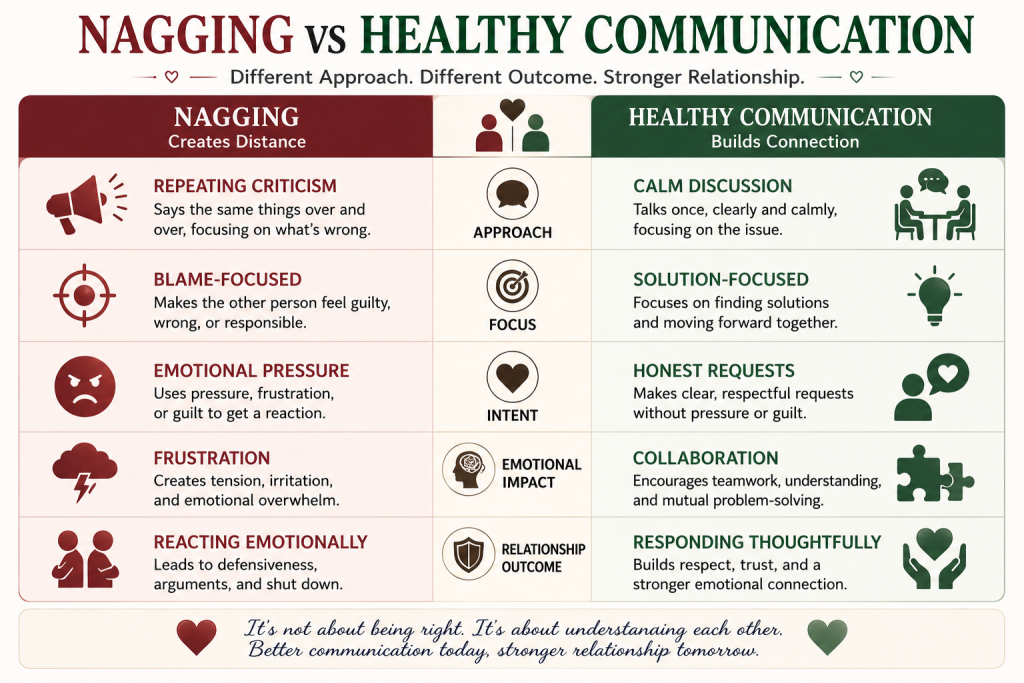
Nagging isn’t a gender-specific habit or a personality flaw, but it’s a communication pattern that begins when partners stop feeling understood, supported, or heard. Nagging sometimes reflects things like:
- A need for there to be a partnership.
- A need to feel valued.
- A need for reliability.
- A need for their partner to follow through.
When these needs go unmet, the repeated requests start to be a way to restore balance, but they usually have the opposite effect. This is how the nagging cycle repeats itself:
- A request is made.
- The request isn’t done.
- The request is asked again.
- There is an increase in frustration.
- Criticism shows up.
- The other partner withdraws or becomes defensive.
The cycle then starts to repeat itself, and it usually becomes more intense over time. This causes both partners to start feeling stuck, with one feeling ignored and unheard and the other feeling controlled and criticized.
This kind of pattern creates emotional instability and distance, and it causes even little interactions to feel tense.
Triggers Behind Nagging
Nagging might show up in daily life, such as:
- When there are broken promises.
- Doing household responsibilities.
- Different priorities.
- Feeling unimportant.
The real issue isn’t about the task that needs to be done but the meaning behind it. For example:
- If your partner says, “The dishes aren’t done,” it might mean, “I feel overwhelmed right now and need your help.”
By realizing there’s a deeper layer to what your partner is asking, you can help break the pattern of nagging.
The Psychology Behind Nagging
In order to fix nagging, both partners need to know what’s going on beneath the surface.
The partner making the requests often nags because:
- They feel overwhelmed.
- They feel unsupported.
- They worry that their needs won’t be met.
- They are anxious about getting things done.
- They want teamwork and responsibilities that are shared.
This isn’t about control but about trying to feel supported and having balance.
The partner receiving the requests often feels different, such as:
- They feel criticized.
- They have different timing and priorities.
- They feel micromanaged.
- They are overwhelmed by other priorities.
- They want to resist being told what to do.
Even reasonable requests might feel like they are being pressured if the partner asks frequently.
Pursue-Withdrawn Pattern
One common dynamic in a relationship is the pursue-withdrawal cycle. This is when:
- One partner pursues things such as asking, reminding, or pushing.
- The other partner withdraws, such as shutting down, delaying, or avoiding the task.
The more that one partner pushes, the more the other withdraws. This creates a loop such as:
- The pursuer increases the pressure.
- The withdrawer increases the distance.
This can lead to both partners feeling disconnected, even though both are trying to meet their own needs.
Nagging Doesn’t Work
Telling someone to “just stop nagging” sounds simple, but it usually doesn’t fix anything. Advice like “pick your battles” can miss what’s really going on underneath.
The problem isn’t just the behavior, but it’s what’s behind it. Here’s why that kind of advice doesn’t always work:
- It overlooks emotional needs that aren’t being met.
- It focuses on what’s happening, not why it’s happening.
- It doesn’t take both people’s experiences into account.
- It shuts down communication instead of helping it improve.
When the real issue isn’t addressed, the same pattern tends to show up again, but it just shows up in a different way.
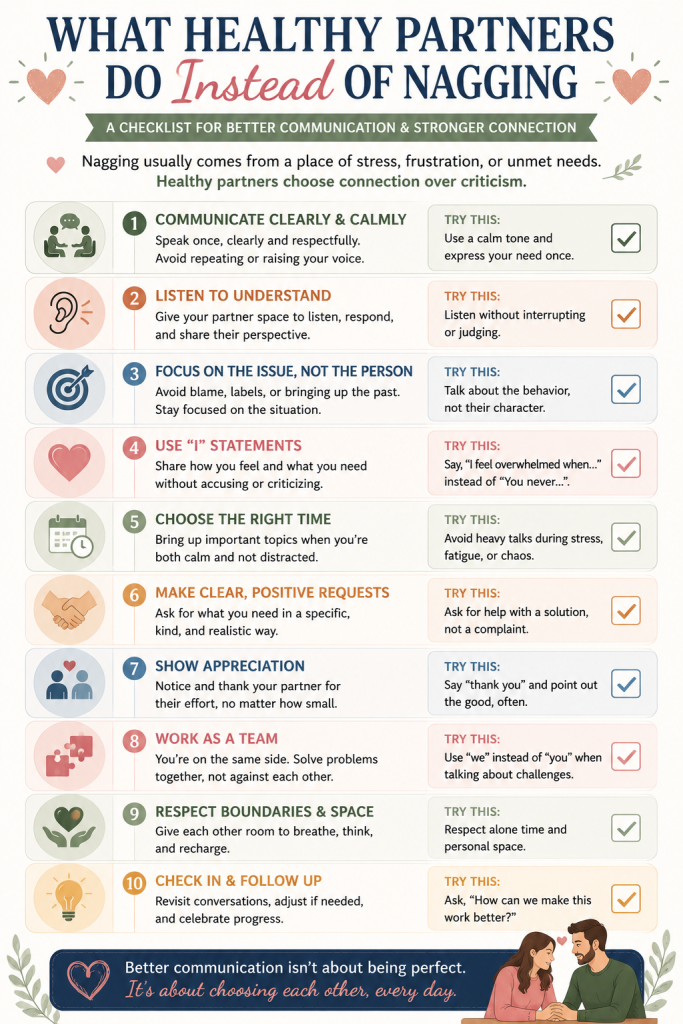
A Good Way to Express What You Need
If you want things to change, the conversation has to shift a little. Instead of saying:
- “You never help around here.”
Try something like:
- “I’ve been feeling overwhelmed handling everything on my own. I need us to share this more.”
That small shift can:
- Lower defensiveness.
- Help your partner actually hear you.
- Turn it into a team conversation instead of an argument.
Be Clear in What You’re Asking
Vague requests can lead to confusion or no follow-through at all. It helps to be:
- Specific, such as asking, “Can you take care of the kitchen tonight?”
- Time-based, such as “Can you do this before the weekend?”
- Focused on one thing at a time.
Clarity makes it easier for things to actually get done.
Notice the Effort Your Partner is Making
Even small things matter. When effort is acknowledged:
- People are more likely to keep helping.
- It feels like appreciation instead of criticism.
- The overall tone of the relationship improves.
How You Respond Matters
How you respond matters just as much. Instead of saying, “I’ll get to that later.”
Try saying:
I hear you. I can take care of that tomorrow morning since I’m busy right now.” This shows that:
- You’re listening.
- You understand what’s being asked.
- You’re making a plan.
One of the biggest ways to break the cycle is to act before reminders happen. When you:
- Follow through consistently.
- Let your partner know your plan.
- Pay attention to what needs to be done.
These things can naturally reduce repeated requests from your partner.
Following Through
Consistency builds trust more than anything else. If something changes, just communicate it:
- “I won’t get to it today, but I’ll handle it tomorrow.”
That kind of reliability makes a big difference as time goes on.
More Than Nagging
Sometimes, what looks like nagging is actually a sign of something deeper. You might notice things like:
- Ongoing frustration or resentment.
- The same arguments are happening over and over.
- One person is starting to shut down emotionally.
- Tension is spreading into other areas of the relationship.
When it gets to that point, outside support can really help unpack what’s going on and reset the dynamic.
From Frustration to Working as a Team
The biggest change happens when you stop seeing it as one person’s fault and start seeing it as a pattern you both can shift. When that happens, relationships usually start to feel:
- More balanced.
- More cooperative.
- More connected emotionally.
- Less stressed over small things.
Instead of feeling like you’re against each other, it starts to feel like you’re on the same side again.
Final Thoughts: Nagging Isn’t About Chores
What people call “nagging” usually isn’t about chores or small tasks. It’s about wanting to feel heard, supported, and considered by your partner.
When those needs are communicated clearly and responded to with effort and understanding, the whole tone of the relationship changes. What used to feel like tension can actually turn into something that brings you closer.
FAQ
1. What does nagging mean in a relationship?
Nagging means repeatedly asking, reminding, criticizing, or pushing a partner about the same issue, often because one person feels unheard or unsupported.
2. Why does nagging happen in relationships?
Nagging often happens when needs are not being met, communication breaks down, responsibilities feel unequal, or one partner does not feel listened to.
3. Is nagging always a bad thing?
Nagging is usually a sign that something deeper needs attention. The repeated behavior may be unhealthy, but the concern behind it may still be valid.
4. What is the difference between nagging and reminding?
A reminder is usually calm, occasional, and helpful. Nagging is repetitive, frustrated, and can make the other person feel criticized or pressured.
5. Why does nagging make a partner defensive?
Nagging can feel like criticism, blame, or control. When someone feels attacked, they may shut down, argue, avoid the topic, or become defensive.
6. What does nagging really mean emotionally?
Emotionally, nagging may mean “I feel ignored,” “I need help,” “I feel overwhelmed,” or “I am afraid this problem will not change.”
7. Can nagging damage a relationship?
Yes. Constant nagging can create resentment, emotional distance, defensiveness, stress, and repeated conflict if the real issue is never addressed.
8. How can couples stop the nagging cycle?
Couples can stop the cycle by slowing down, identifying the real need, speaking calmly, listening fully, making clear requests, and following through.
9. What should I say instead of nagging?
Try saying, “I feel overwhelmed and need help with this,” or “Can we agree on a plan?” instead of repeating blame or criticism.
10. How do I ask for help without nagging?
Be specific, calm, and direct. Explain what you need, why it matters, and when you need it without attacking your partner’s character.
11. What if my partner ignores my requests?
If your partner ignores reasonable requests, have a direct conversation about follow-through, shared responsibility, and how the pattern affects the relationship.
12. Why do small issues turn into big arguments?
Small issues can become big arguments when they represent deeper concerns, such as feeling disrespected, unsupported, unheard, or emotionally disconnected.
13. How can I respond when my partner nags me?
Try listening for the need behind the complaint. Instead of reacting defensively, ask what would help and agree on a realistic next step.
14. Is nagging a sign of control?
Sometimes nagging can become controlling if it turns into pressure, criticism, monitoring, or attempts to force a partner to act a certain way.
15. Can nagging come from stress?
Yes. Stress, mental overload, unequal responsibilities, anxiety, and emotional exhaustion can make someone more likely to repeat requests impatiently.
16. How do healthy partners handle repeated problems?
Healthy partners discuss the issue calmly, focus on solutions, divide responsibilities clearly, appreciate effort, and revisit the plan when needed.
17. What are better communication habits than nagging?
Better habits include using “I” statements, choosing the right time, making clear requests, listening without interrupting, and focusing on teamwork.
18. How can appreciation reduce nagging?
Appreciation helps partners feel noticed and valued. When people feel respected, they may be more willing to cooperate and follow through.
19. When should couples seek help for nagging?
Couples may benefit from support if nagging turns into constant conflict, resentment, avoidance, emotional distance, or repeated arguments that never improve.
20. What is the healthiest way to fix nagging?
The healthiest way is to replace repeated criticism with honest requests, active listening, shared responsibility, emotional validation, and consistent follow-through.