

A familiar song arrives at a meaningful moment. A dream leaves you feeling comforted. Someone offers help just when you were wondering how to move forward. If you believe in spirit guides or guardian angels, you may understand these moments as reminders that you are supported.
You can welcome that personal meaning without needing every moment to contain a message. Begin by noticing what happened, how you felt and what response would bring care into your life. A connection can feel meaningful while its cause remains uncertain.
What do the words mean to you?
People use spirit guide and guardian angel within different spiritual and religious frameworks. Some distinguish angels from ancestors or other guiding presences; others use the language more personally. You do not have to combine beliefs that do not fit your tradition.
Rather than trying to obtain a name immediately, ask what kind of relationship you are hoping for: comfort, a space for reflection, a reminder of your values or courage to take a practical step. Let your own beliefs shape the language.
Five everyday starting points
1. Nature
Notice: a bird, a plant, the weather or a detail that holds your attention.
Reflect: what association does it have for me? You can appreciate a moment outdoors without requiring an animal to deliver a message.
2. Dreams
Notice: the setting, emotion and one image you remember.
Reflect: does it connect with a current hope, memory or concern? Keep the dream separate from claims about another person’s private thoughts.
3. Music and words
Notice: the phrase that stood out and what was happening when you heard it.
Reflect: why did those words matter today? A comforting association does not need to become an instruction.
4. Help from another person
Notice: what someone actually offered.
Reflect: how can I receive or acknowledge the kindness? Feeling that a meeting was timely does not remove the need for consent and ordinary boundaries.
5. An opportunity or a change of pace
An invitation, a new role or a change of plans may invite reflection about direction. You might understand it spiritually while still checking the details. Ask what is being offered, what it would require and whether you actually want it.
A disappointment does not have to be called a gift before you can respond to it. An injury, illness or loss is not proof that a guide caused harm to teach a lesson. Attend to the practical need and allow meaning to emerge in your own time.

A short, optional way to reflect
- Choose an ordinary setting. Sit comfortably and notice your surroundings. You can keep your eyes open.
- State one intention. For example, “I would like to approach this change with patience.” You may use a prayer that fits your beliefs.
- Allow a quiet pause. Notice thoughts, memories or images without forcing them or deciding immediately where they came from.
- Record what was present. A phone note with a few plain details is enough. “Nothing particular came to mind” is a valid entry.
- Close and return to daily life. Choose one manageable step that fits your values and the information you have.
You do not need to raise a score, repeat a ritual until it feels perfect or buy something to earn support. If the practice becomes uncomfortable, stop and return to a familiar routine.
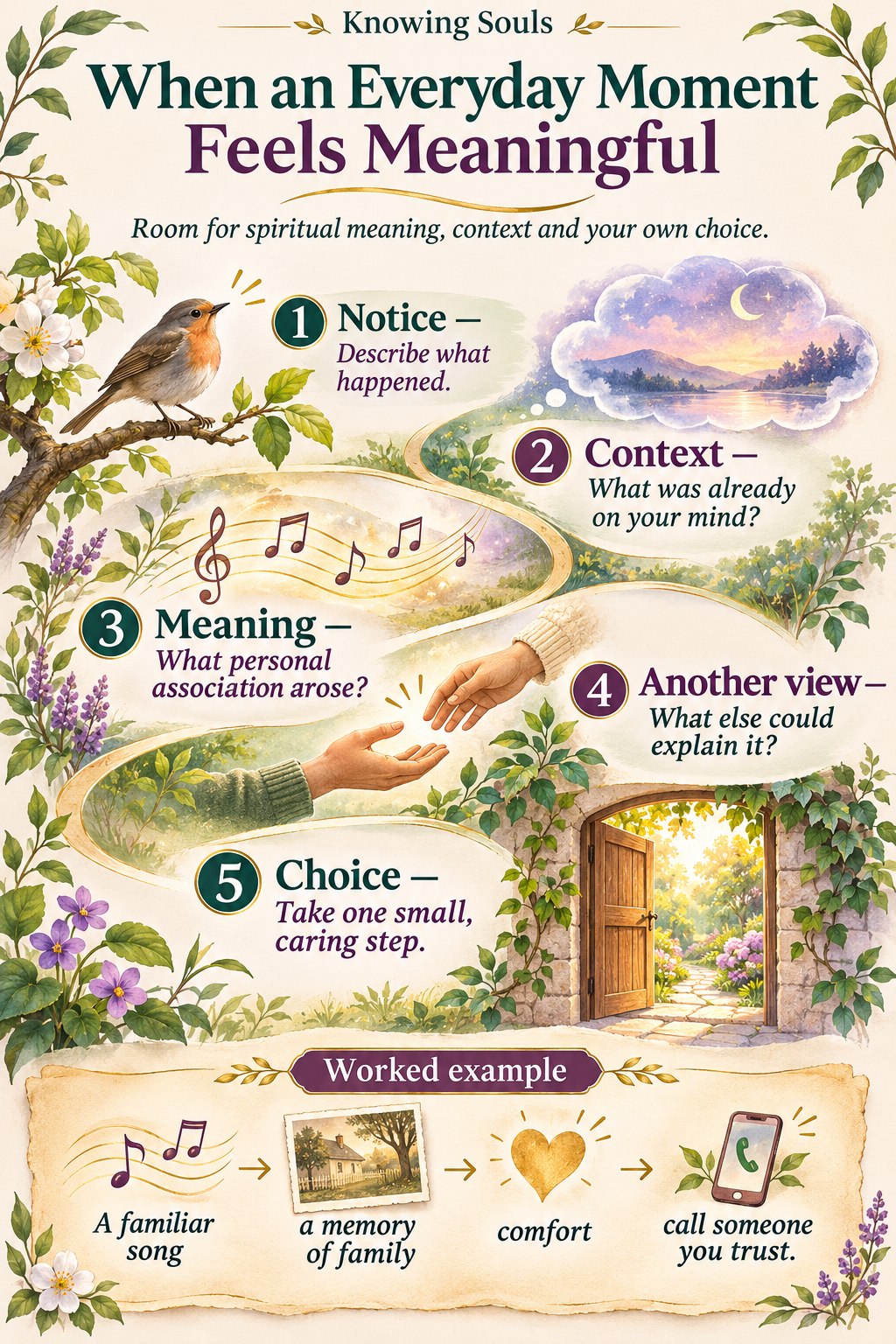
Free sign-reflection log
Copy these headings into a private note. Use one entry for a moment you want to remember.
- Event: what happened, where and when?
- Context: what was already on my mind?
- Association: what meaning did I connect with it?
- Alternative: what other explanation could fit?
- Choice: what small, considerate action could I take?
- Review: what did I learn after acting?
Example: “A song reminded me of a relative while I was worried about a move. I felt comforted. It may also have stood out because I was thinking about family. I will call someone I trust and ask for practical moving help.”
Let guidance leave room for your choice
A kind interpretation should not require you to surrender your judgment, spend beyond your means or stay in a harmful relationship. A reader’s statement about a guide does not establish a fact about another person’s motives, your health or what must happen next.
Our guide to divine timing, readiness and choice explores how spiritual trust can coexist with action. The article on soul contracts and boundaries keeps personal freedom central when a spiritual label touches a relationship.
Frequently asked questions
1. Are spirit guides and guardian angels the same?
People distinguish them in different ways depending on their beliefs and traditions. You do not need to combine meanings that do not fit your own framework.
2. How can I begin exploring a connection?
Choose one intention, take a short quiet pause and record what you notice without forcing an image or message.
3. Do I need to learn a guide’s name?
No. You can reflect on comfort, values and choices without identifying or naming a presence.
4. Can nature feel like a sign?
Yes, it may carry a personal association. That meaning does not establish that an animal, plant or event was sent to deliver a message.
5. Can I reflect on a song that arrives at the right moment?
Record the words that mattered, the context and the association you made. You can value the comfort while leaving the cause open.
6. Are dreams always messages from guides?
No. You can explore a spiritual interpretation without assuming every dream comes from a guide or describes an external event.
7. Does a dream reveal someone else’s thoughts?
A dream does not establish another person’s private thoughts or intentions. Ask directly where appropriate rather than treating the dream as evidence.
8. Does a timely meeting mean I must trust the person?
No. You can appreciate the timing while keeping ordinary boundaries and getting to know the person through their behavior.
9. What if nothing comes to mind during reflection?
That is a valid experience. You do not need a vivid impression to justify your practice or prove that you are supported.
10. Must I feel spiritually positive first?
No. You can acknowledge grief, uncertainty or tiredness without treating those feelings as a failure to connect.
11. Was an injury a lesson arranged by a guide?
An injury does not establish that a guide caused harm to teach you. Attend to practical care and allow yourself time before assigning meaning.
12. What belongs in the free log?
Record the event, context, personal association, another possible explanation, a manageable choice and what you learned later.
13. Can a reader make decisions for me through a guide?
A statement about guidance does not remove your choice. You can disagree, ask questions and seek direct information or appropriate expertise.
14. What if I feel pressured to decode everything?
Take a break. It is fine to leave events unexplained and seek support from someone who respects your freedom to question.
15. What is a useful response to a comforting sign?
Choose an ordinary action linked to the meaning, such as contacting a trusted person, expressing appreciation or preparing for a practical task.