

A trial separation can create breathing room, but distance by itself does not repair a relationship. The couples most likely to get useful clarity from time apart are usually the ones who agree on why they are separating, what the boundaries are, how long the initial period will last, and what work each person plans to do during it.
What Is a Trial Separation?
A trial separation is an informal period in which partners live apart or reduce day-to-day contact while deciding what they want next. It is different from a legal separation. Legal, financial, custody, housing, and immigration consequences can vary by location, so couples who need legal guidance should speak with a qualified professional.
Why Couples Consider Taking Space
Constant conflict can make every conversation feel reactive. Financial stress, parenting demands, burnout, unresolved resentment, or repeated communication breakdowns can make it difficult to think clearly while living inside the same pattern.
When Space Can Help
Space may be useful when both partners still care about the relationship, both are willing to reflect honestly, and the purpose is clarity rather than punishment. Time apart can lower immediate conflict enough for people to notice what they miss, what feels better, and which problems need direct work.
Distance Can Also Reveal Relief
Sometimes a partner discovers that they feel consistently calmer, safer, or more like themselves while apart. That information matters too. A trial separation should not be designed to force reconciliation; it should create enough structure for honest observation.
Time Apart Does Not Automatically Fix Problems
If the separation is used only to avoid difficult conversations, the same patterns usually return. Growth requires reflection, changed behavior, and better communication. Reviewing repeated communication patterns can help couples identify the cycle rather than simply blaming one person.
Agree on the Purpose
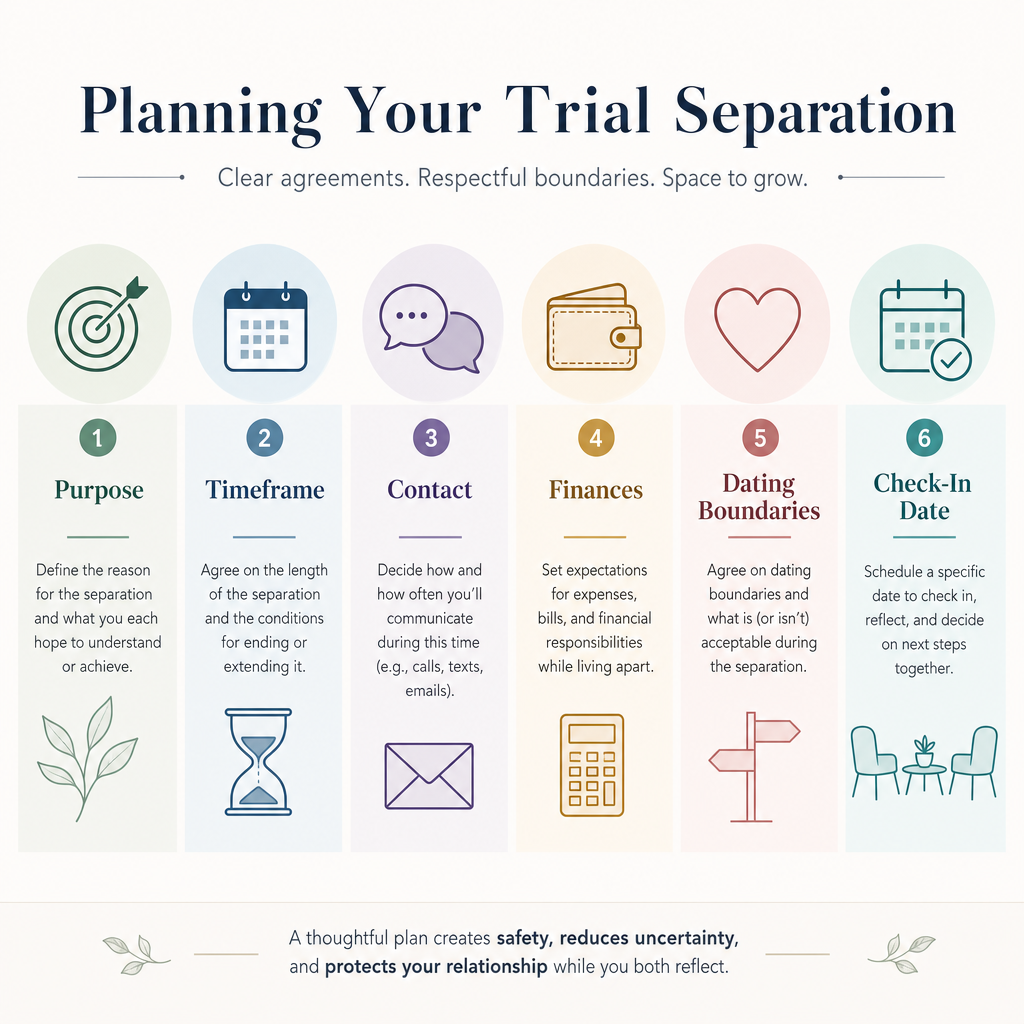
Each partner should be able to explain why the separation is happening in one or two sentences. Examples include reducing conflict, deciding whether to recommit, working on individual issues, or creating a safer environment for thoughtful conversations.
Set a Review Date
An open-ended separation can intensify uncertainty. Choose an initial review date that gives enough time for the intensity to settle but does not leave both people in indefinite limbo. The review is a checkpoint, not a forced deadline for reconciliation or divorce.
Decide How Communication Will Work
Agree on how often you will communicate, which channels to use, and what topics require immediate contact. Couples with children will need a reliable co-parenting communication plan even if relationship conversations are temporarily limited.
Discuss Dating and Physical Intimacy
Do not assume you have the same definition of separation. If reconciliation is still being considered, dating other people can add jealousy, confusion, and trust problems. Make explicit agreements rather than relying on assumptions.
Plan for Finances, Parenting, and the Home
Discuss bills, access to accounts, schedules, pets, childcare, transportation, and household responsibilities. For major financial or legal questions, get advice appropriate to your jurisdiction.
Use Counseling When It Is Appropriate
Couples counseling can help partners slow down reactive conversations, identify patterns, and decide what meaningful change would look like. Individual therapy can also be useful when each partner needs space to work on personal concerns.
How Trial Separation Affects Children
Children benefit from predictable routines and age-appropriate explanations. Avoid asking them to carry messages, choose sides, keep secrets, or absorb adult details. Speak respectfully about the other parent and prioritize stability.
When a Trial Separation Is Not a Repair Strategy
If there is abuse, coercive control, stalking, threats, or fear for safety, a conventional relationship-repair process may be inappropriate. Prioritize safety and seek qualified domestic-violence, legal, or emergency support as appropriate. Do not use couples counseling as a substitute for safety planning in abusive situations.
Signs the Separation Is Producing Useful Information
You are learning something specific about the relationship, communication is becoming less reactive, each person is following agreed boundaries, and both can identify concrete changes that would be required for reconnection.
Signs It May Be Making Things Worse
The separation is being used to punish or manipulate, agreements are repeatedly broken, one partner is kept in indefinite uncertainty, hostility escalates, or neither person is willing to reflect or change.
Final Thoughts
A trial separation is a framework for gaining information, not a guaranteed way to save a relationship. Clear purpose, boundaries, accountability, and appropriate professional support can make the period more constructive. The outcome may be reconciliation, a decision to separate permanently, or simply a clearer understanding of what each person needs next.
Frequently Asked Questions
1. What is a trial separation?
A trial separation is an informal period of living apart or reducing day-to-day contact while partners evaluate the future of their relationship.
2. Is a trial separation the same as legal separation?
No. A trial separation is usually informal, while legal separation can create formal legal rights and obligations that vary by jurisdiction.
3. Can a trial separation save a relationship?
It can help some couples gain clarity and change patterns, but it does not guarantee reconciliation.
4. How long should a trial separation last?
There is no universal length. Couples often benefit from agreeing on an initial review date rather than leaving the period completely open-ended.
5. Should we set rules for a trial separation?
Yes. Clear expectations around communication, dating, finances, parenting, housing, privacy, and the review process reduce confusion.
6. Should we date other people during a trial separation?
If reconciliation is being considered, dating others can add complexity. The important point is to make an explicit agreement rather than assume.
7. How often should we communicate?
Choose a schedule that supports the purpose of the separation while still covering practical responsibilities, especially co-parenting.
8. Can we still go to couples therapy while separated?
Yes. Therapy can help with communication, accountability, decision-making, and understanding recurring relationship patterns.
9. Does needing space mean the relationship is over?
Not necessarily. Some people need distance to regulate emotions and think clearly, while for others it may reveal that they want to end the relationship.
10. What should the purpose of a trial separation be?
Useful purposes include reducing conflict, gaining clarity, working on individual concerns, and identifying what would need to change for reconciliation.
11. How do we handle money during a separation?
Agree on bills, accounts, housing costs, debts, and shared expenses. Seek qualified legal or financial advice when the stakes are significant.
12. How do we explain a trial separation to children?
Use calm, age-appropriate language, maintain routines, avoid blaming the other parent, and keep children out of adult conflict.
13. Can a trial separation make things worse?
Yes. Unclear expectations, manipulation, indefinite uncertainty, broken agreements, or outside relationships can intensify distress.
14. What is emotional withdrawal?
Emotional withdrawal is disengaging from vulnerability and communication rather than using space intentionally for regulation and reflection.
15. How do we know if the separation is helping?
Look for lower reactivity, clearer thinking, respect for boundaries, meaningful personal work, and specific insight about what needs to change.
16. What if only one partner wants the separation?
The other partner cannot be forced to feel comfortable with it. Clear communication and professional guidance may help both people understand options and boundaries.
17. Is a trial separation appropriate when there is abuse?
A standard reconciliation-focused trial separation is not a safety plan. When abuse or coercive control is present, prioritize safety and qualified support.
18. Can psychic guidance tell us whether to reconcile?
Psychic guidance should not be treated as certainty about a partner’s intentions or as a substitute for safety, counseling, legal advice, or your own judgment.
19. What should happen at the review date?
Discuss what each person learned, whether agreements were followed, what has changed, and whether the next step is reconciliation, more structured work, or permanent separation.
20. What makes a trial separation most constructive?
A shared purpose, clear boundaries, a review date, honest reflection, practical planning, and appropriate professional support.