
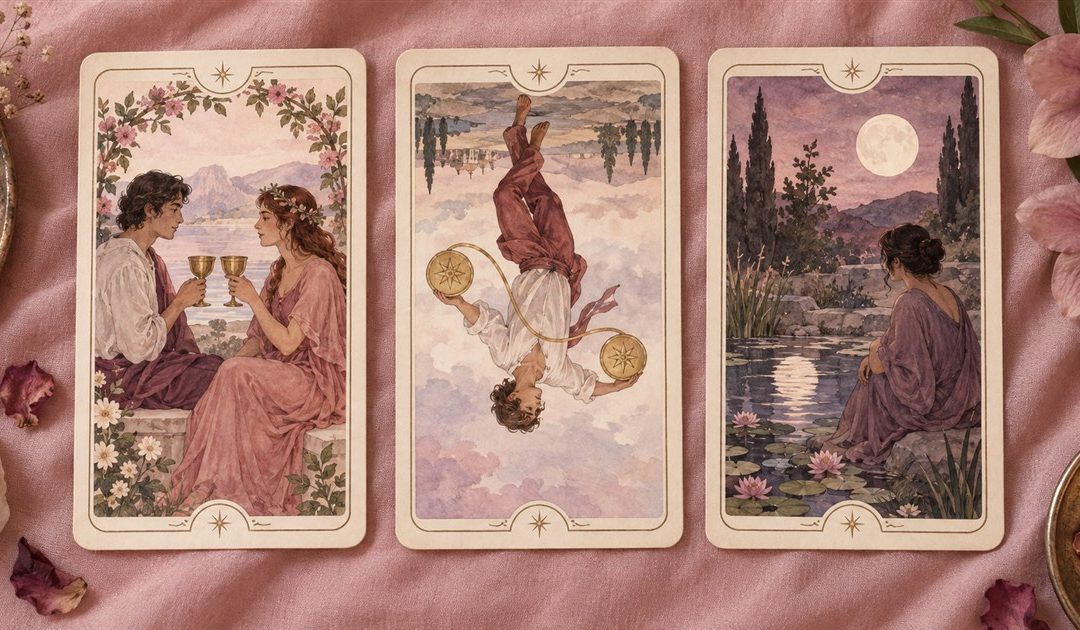
A reversed card in a relationship spread changes the interpretation only through the method you choose. It does not automatically mean separation, betrayal or a loss of affection.
Define one reversal rule and three clear positions before drawing. Then connect each card’s upright theme, position and orientation to your own observations and choices.
A three-card relationship practice spread
| Position | Fictional example card | Reflective question |
|---|---|---|
| What I bring | Knight of Cups reversed | Are my hopes moving faster than our agreements? |
| What needs clarification | Two of Pentacles upright | What time and commitments are actually available? |
| A respectful next step | Queen of Swords upright | How can I state my preference and listen to the reply? |
Scroll sideways to see the full table.
Choose a Reversal Method Before You Start
A reversal is a card oriented upside down in the reading arrangement. This position can have meaning through the interpretive methods you use, and it’s not a separate card with one universally accepted message.
Some readers use reversals as a quality that’s hard to express, while others consider it an inward focus, excess, delay, or a different meaning given by the deck’s guide. These different approaches shouldn’t be switched on and off to get you the answers that you want.
Joan Bunning's lesson on reversed cards offers one practitioner’s approach and emphasizes deciding whether to use reversals consistently. You can learn from an established method while recognizing that it is a spiritual teaching, not scientific validation of the reading.
Before you shuffle the deck, write down a rule for this reading. You might say, “I’ll read the reversals as places where the card’s theme needs more attention.” Then keep the rule the same for the whole reading.
Relationship Questions
A question such as “How can I approach this disagreement?” concerns your own response. Asking what another person is secretly planning invites unsupported claims about information the cards cannot establish.
If you want to reflect on the relationship with your partner, both of you need to understand the purpose and have the choice to decline. If you’re interested in tarot, that doesn’t mean somebody else has to accept a card interpretation as part of their life.
If you get your own reading, think about what you’ve actually observed and what you don’t really know. The spread can look at your response to uncertainty without trying to take away the need for communication.
Don’t ask the same question over and over again until the answer changes. A different drawing can show another story, but it doesn’t mean that the first story was false or that a new one has more truth.
Read Relationship Reversals Clearly: visual guide
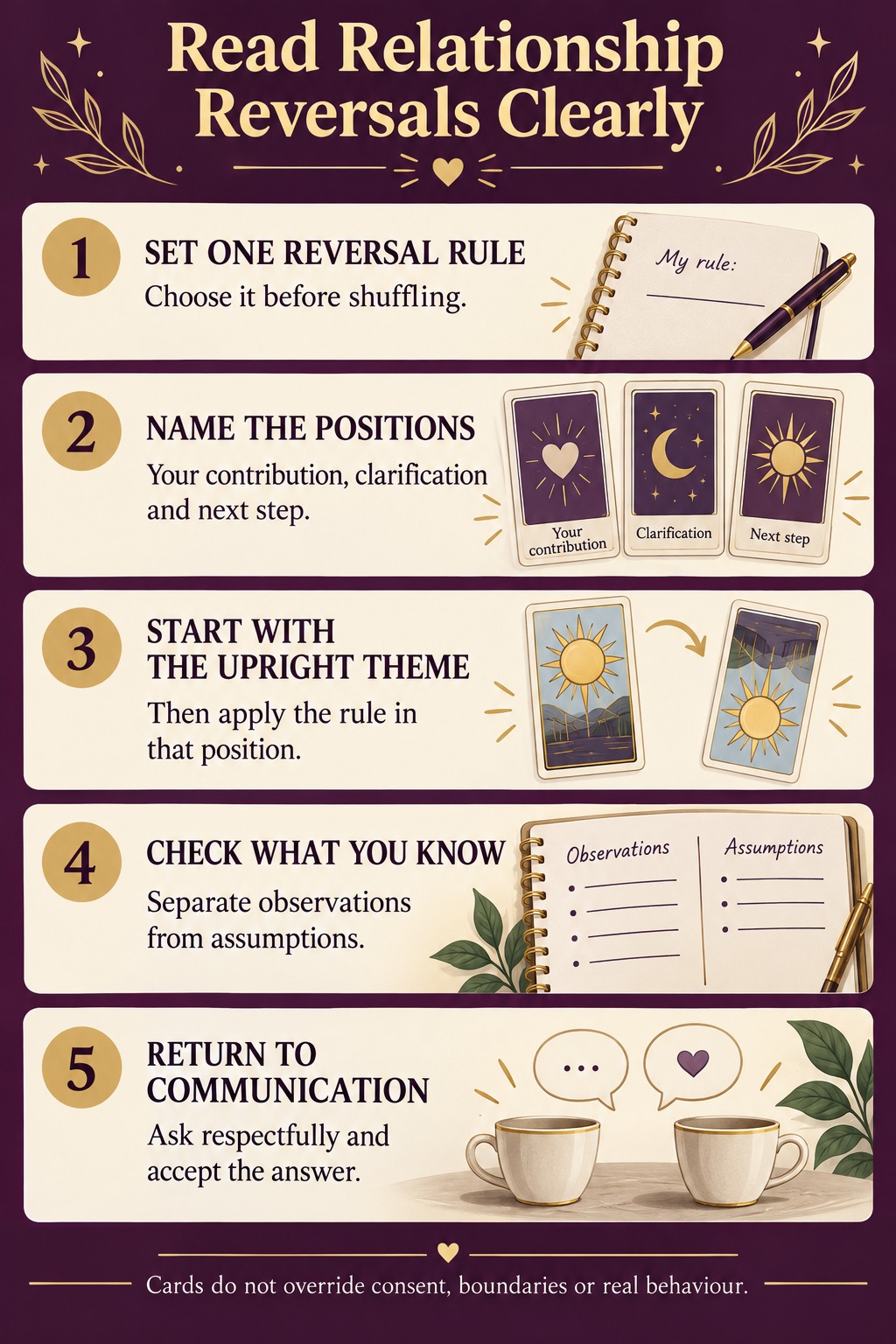
Read the infographic as text
- 1. SET ONE REVERSAL RULE: Choose it before shuffling.
- 2. NAME THE POSITIONS: Your contribution, clarification and next step.
- 3. START WITH THE UPRIGHT THEME: Then apply the rule in that position.
- 4. CHECK WHAT YOU KNOW: Separate observations from assumptions.
- 5. RETURN TO COMMUNICATION: Ask respectfully and accept the answer.
Setting the Position
A relationship spread is easier to handle when the positions are specific. Use what I’m bringing, for example, what deserves clarification, and one respectful next action step as positions. These positions focus on reflection and action instead of a verdict about the relationship’s future.
Bunning's explanation of tarot spreads describes how a card’s position influences interpretation. A reversal in a position about your response should therefore be read in that context, not automatically assigned to an absent partner.
Keep the position names beside the cards when you’re learning. If you find yourself going on about a story about a third person, go back to the words you picked before the draw. The original question is a good boundary.
Avoid position labels that assume a hidden fact. “What needs clarification?” leaves room for uncertainty; “the truth they are hiding” assumes deception before the draw.
Start With the Upright Meaning
Before trying to understand a reversed tarot card, start by thinking about what the card usually means when it is upright. For example, the Two of Cups is often connected with mutual feelings, partnership, and connection. The Four of Pentacles can represent holding on or protecting what you have, while Strength can represent patience, courage, and inner strength.
These are only examples because tarot cards can have different meanings depending on the deck, the question, and the way you learned to read them. Your deck’s guidebook can be a good place to start, especially while you are learning. Try not to pick an unusual or dramatic meaning just because it happens to fit the story you already have in your mind.
Next, look at where the card appears in the spread and what that position is asking you to think about. If the position represents something that needs clarification, think about how the card’s usual meaning connects with something that is unclear in your situation. From there, you can consider what the reversal might change about that meaning.
Doing it this way can keep you from automatically seeing every reversed card as something negative. You are still reading the meaning of the card and how it connects with your question. The fact that it appeared upside down is only one part of the interpretation.
Don’t Give One Reversed Card Every Possible Meaning
If you read reversals as a sign that something about the card’s usual meaning needs attention, think about what might need to change. Maybe there is too much or too little of that energy in the situation. You might also be having trouble expressing that quality or putting it into action.
Try to connect the interpretation with what you already know about the situation. For example, if you pull a reversed card connected with communication after you and your partner have misunderstood several messages from each other, it could encourage you to have a clearer conversation. It does not automatically mean that someone is lying or intentionally hiding something.
You also do not need to keep adding meanings until one card somehow explains the entire relationship. If you decide that a card means someone is emotionally blocked, hiding something, moving too slowly, doing too much, and healing from the past all at the same time, the reading can become more confusing than helpful.
Sometimes a simple question can give you more to think about than a complicated interpretation. Something like, “Have we actually talked about what regular communication means to both of us?” can help you identify something that you can discuss instead of trying to make one tarot card answer everything.
A Three-Card Relationship Example
Imagine a fictional reader named Brooke who is unsure about the pace of a new relationship. She asks, “What should I think about before talking with this person about how often we spend time together?” She uses three positions: what I bring to the situation, what needs clarification, and a respectful next step.
Brooke pulls the Knight of Cups reversed, the Two of Pentacles upright, and the Queen of Swords upright. She reads reversed cards as something to look at a little differently rather than automatically treating them as a bad sign or prediction.
With the reversed Knight of Cups, Brooke asks herself if her hopes for the relationship might be moving faster than what the two of them have actually talked about or agreed on. This gives her something to consider about her own feelings and expectations. She does not assume that the reversed Knight of Cups means the other person is dishonest or does not care about her.
The Two of Pentacles gets her thinking about practical things like schedules and how much time they realistically have available, while the Queen of Swords encourages clear and honest communication. Brooke decides that her next step is to explain what she would like and ask the other person what works for them. Instead of trying to use the cards to decide what the other person is thinking, she can listen to what they say and pay attention to their actions as the relationship develops.
Reading Reversals
A reversed Sun or Ten of Cups card doesn’t mean that the conclusion of happiness is impossible. Looking at the method in the position, you might look at expectations, a hard time enjoying what’s present, or see a gap between the picture and your daily experiences.
A reversed Ten of Cups in a position about expectations, for example, could make someone look at their social media images of a perfect relationship and their standards. This is a reflection and not a diagnosis of the relationship.
Ask what the positive theme means in regular terms. Does the connection mean that you spend time together, have emotional openness, or are doing shared planning? Clarify the desired quality, which can make the reading better without promising what’s going to happen.
Don’t try to force a reassuring meaning either. If there’s actual behavior that’s concerning, a positive-looking card shouldn’t be used to make this smaller. The relationship has to be looked at through more than just emotional tone and artwork.
Reading Without Predicting Harm
Cards such as the Tower, Death, or the Three of Swords can have strong associations. Reversed cards cannot diagnose danger, forecast death or prove betrayal; upright cards cannot do those things either.
In the method you picked, a hard image might cause reflection on change, grief, avoidance, or recovery. Keep the question connected to what you know. If you’ve recently experienced a breakup, reflecting on recovery might fit, but predicting another person’s tragedy doesn’t work with this card.
If the images are overwhelming, put the deck away and go back to getting support. You don’t have to clarify cards to say that you’re safe from a supernatural threat.
If you have a safety concern, respond to the behavior or the situation itself. Threats, coercion, or violence need appropriate support, no matter what the spread says.
Don’t Diagnose with the Cards
A reversed court card doesn’t mean that someone is a narcissist, emotionally abusive, unfaithful, or incapable of love. These labels make serious claims that can’t be supported by a shuffled deck.
Describe the observation without a diagnosis: “They cancelled several plans without suggesting alternatives.” You can discuss that pattern in context; a reversed court card does not prove control or a particular motive.
The relationship spectrum from love is respect offers a separate, behavior-based reference for healthy, unhealthy, and abusive dynamics. Use that kind of information when assessing treatment within a relationship.
Tarot cards can help you pay attention to a question you want to ask. They shouldn’t turn uncertainty into a diagnosis or give either person authority to say what the other person is feeling.
Respect Boundaries No Matter What the Cards Say
A tarot card does not change the boundary that someone has already given you. If someone has said no or asked you not to contact them, pulling the reversed Two of Cups does not secretly mean they want you to keep trying. The same is true if you pull cards that seem very positive. They do not override what the person has actually told you.
If you are not sure if someone wants to hear from you, pay attention to what they have said and done instead of trying to use the cards to find a hidden message. A reading about unfinished feelings or unresolved energy does not mean you should create another account after being blocked, ask friends to find information about the person, or unexpectedly show up somewhere to see them.
Privacy is also something to think about when you are getting a reading about a relationship. Before sharing private information about a partner with a reader or posting an entire spread about them online, think about how much of their personal information you are sharing. Even if you only use their first name, other details in the story could make it easy for someone to figure out who you are talking about.
Tarot can still help you explore how you feel about a boundary or why it is difficult for you to accept. The difference is that the reading should help you understand your own feelings rather than become a reason to ignore someone else’s decision. Both people should still have the freedom to make their own choices.
What If You Pull Several Reversed Cards?
Seeing several reversed cards in one spread can definitely make a reading look more dramatic than it actually is. It does not automatically mean that you are cursed, your relationship is doomed, or you need to immediately pay someone for a cleansing. Cards can end up reversed simply because of the way the deck was shuffled or handled, and their meaning also depends on how you have decided to read reversals.
Instead of focusing on how many cards are upside down, read each card according to its position in the spread and the question you asked. Then look for one or two themes that seem to appear throughout the reading. Having several reversed cards does not mean that every part of your relationship or situation has something wrong with it.
If a spread becomes so complicated that you are more confused after the reading than you were before it, you can make things simpler next time. Try using fewer cards or practicing reversals with fictional situations until you become more comfortable interpreting them. You do not have to understand every possible meaning of every card immediately, and you certainly do not have to pay for a bigger reading just because several cards appeared reversed.
The same idea applies when most or all of your cards are upright. A spread filled with cards that look positive can feel reassuring, but it cannot promise that a relationship will work out exactly the way you hope. Tarot can give you something to think about, but what happens in the relationship will still depend on the people involved and the choices they make.
After the Reading
Keep a short note of the original question, the positions of the card, and the interpretation you made. If a later event reminds you of the spread, compare it with the note instead of expanding the wording until it fits perfectly.
You might say, “I should clarify our scheduling expectations,” and this is different from saying that the cards predicted that we would cancel Saturday. The second statement shouldn’t be tied to the reading unless it’s actually recorded, even when the match doesn’t show the results.
Also, write down when a suggested theme didn’t fit the conversation or showed a different explanation. This helps you to be more careful as a reader. You can value reflection but stay honest about the limits.
Final Thoughts: Ending with a Choice
Always translate the interpretation into plain language. Instead of saying, “Your energy is blocking the connection we have,” say, “I’d like to understand what kind of contact is best for us.” The second sentence asks for an answer without making someone agree with your spirituality.
Pick one action and let the other person respond freely. They might agree, refuse to talk about it, or ask for time. A reading doesn’t mean that you always get the answer you wanted.
If no action is useful for you, keep that as part of your reflection. You might notice an assumption or decide to get more information. Not every spread can be meaningful or have immediate change.
Reversals aren’t as frightening when they stay part of the method. Read the question, position, and cards together, and keep uncertainty available while you let real communication guide your relationship past the spread.
For cards that suggest people or roles, read our guide to tarot court cards in love.
For the next step, explore changing family patterns.
Frequently asked questions
1. What does a reversed love card mean?
There is no universal meaning. It depends on the chosen reversal method, the card’s usual theme and its position in the relationship spread.
2. Does the reversed Lovers mean we will separate?
No. A card cannot establish that outcome. You might reflect on choices or agreements, but the relationship depends on actual people and circumstances.
3. Are reversals required in a relationship spread?
No. You can read upright only. Decide before drawing rather than changing the method when a card feels uncomfortable.
4. What is a useful relationship question?
Ask about your contribution, assumptions or a respectful next step. This gives you something to consider without claiming access to another person’s private thoughts.
5. Which three positions can I use?
Try what I bring, what needs clarification and one respectful next step. Define them before drawing and keep their roles visible.
6. Why start with the upright meaning?
It gives you the underlying theme to modify. Orientation should not erase the card’s context or turn every card into a negative verdict.
7. Can I use several reversal meanings at once?
Choose a clear rule instead of piling on incompatible meanings. A simpler interpretation is easier to explain and compare with the question.
8. What can a reversed Knight of Cups prompt?
In a position about your contribution, it might prompt a check of hopes and expectations. It does not establish that a partner is dishonest.
9. Can the reversed Two of Cups reveal hidden feelings?
No. It can prompt reflection on mutuality or communication within your method, but the other person’s answer still matters.
10. Do reversed positive cards remove all hope?
No. They may prompt attention to how a theme is expressed. Avoid both a forced reassurance and an automatic disaster story.
11. Can a reversal diagnose emotional abuse?
No. Assess behaviour with appropriate support and reliable relationship information. Cards cannot diagnose a person or establish a serious accusation.
12. Do many reversals mean a curse?
No. Deck handling can create reversed orientations. Their number is not evidence of a curse or a reason to buy cleansing services.
13. Can a reading override a request for no contact?
No. Respect a stated boundary regardless of the cards. A symbolic interpretation is not permission to contact someone who has declined.
14. What if my partner dislikes tarot?
They can decline participation. Translate your own reflection into ordinary questions without requiring them to accept the card interpretation.
15. What should I do after the spread?
Record the original wording, one practical question and what remains unknown. Let communication and observation guide the next step.