

A tarot court card in a love reading can suggest a person, a role or a pattern of behaviour. Start with your question and the card’s spread position before deciding which interpretation fits.
Use suit and rank as flexible symbolic prompts. They cannot identify an absent person, establish private intentions or assign someone a fixed gender, age or personality.
Read the court-card layers as questions
| Layer | One common association | Relationship prompt |
|---|---|---|
| Cups | Emotion and connection | How are feelings being expressed? |
| Swords | Thought and communication | What needs to be said clearly? |
| Wands | Initiative and desire | What pace have we actually agreed? |
| Pentacles | Practical life and resources | How are responsibilities shared? |
| Page | Learning and curiosity | What do I still need to understand? |
| Knight | Action and pursuit | Am I acting at a thoughtful pace? |
| Queen | Developing or caring for a quality | How can care include my own needs? |
| King | Responsibility and direction | What decision or agreement needs attention? |
Scroll sideways to see the full table.
Court Cards Not Personality Tests
In a regular Tarot deck, each of the four suits includes a page, a knight, a queen, and a king, which makes 16 court cards. Some decks change the titles or organization. Learn the structure of your own deck before you try to figure out how the guide applies to it.
Joan Bunning's lesson on court cards explains one approach that combines suit and rank. It is a useful example of a practitioner’s interpretive method, not a validated system for classifying people’s personalities.
Court imagery belongs to tarot’s broader history of card design. The Metropolitan Museum of Art's account of tarot structure describes historical court ranks within the suits. Modern readings add more layers of symbolic interpretation to the visuals.
You don’t have to force every person into one card. Someone might be decisive at work, hesitant when it comes to romance, and kind with their friends. The role can change with the situation, which is one reason flexible court card reading is better than picking a label.
Look at the Label
If a card shows up in a position called “How I Can Respond,” start by considering the qualities that you can bring to a situation. Going right to a mysterious third person ignores the role you gave the position before you drew.
If the position is about a known interaction, a person-based interpretation might be better. This still requires caution, though. The card can help with reflection on your behavior that you can observe, but it can’t verify hidden thoughts of someone else.
Write the position in a complete sentence, such as “This card helps me to look at how I communicate a boundary.” Then allow the core image to connect to that sentence. This is an easy step that keeps the reader attached to the purpose.
If none of the interpretations fit, then leave the card unresolved. You don’t have to invent another romantic interest or secret problem just to make every image a dramatic story.
Court Cards: Person, Role or Pattern: visual guide
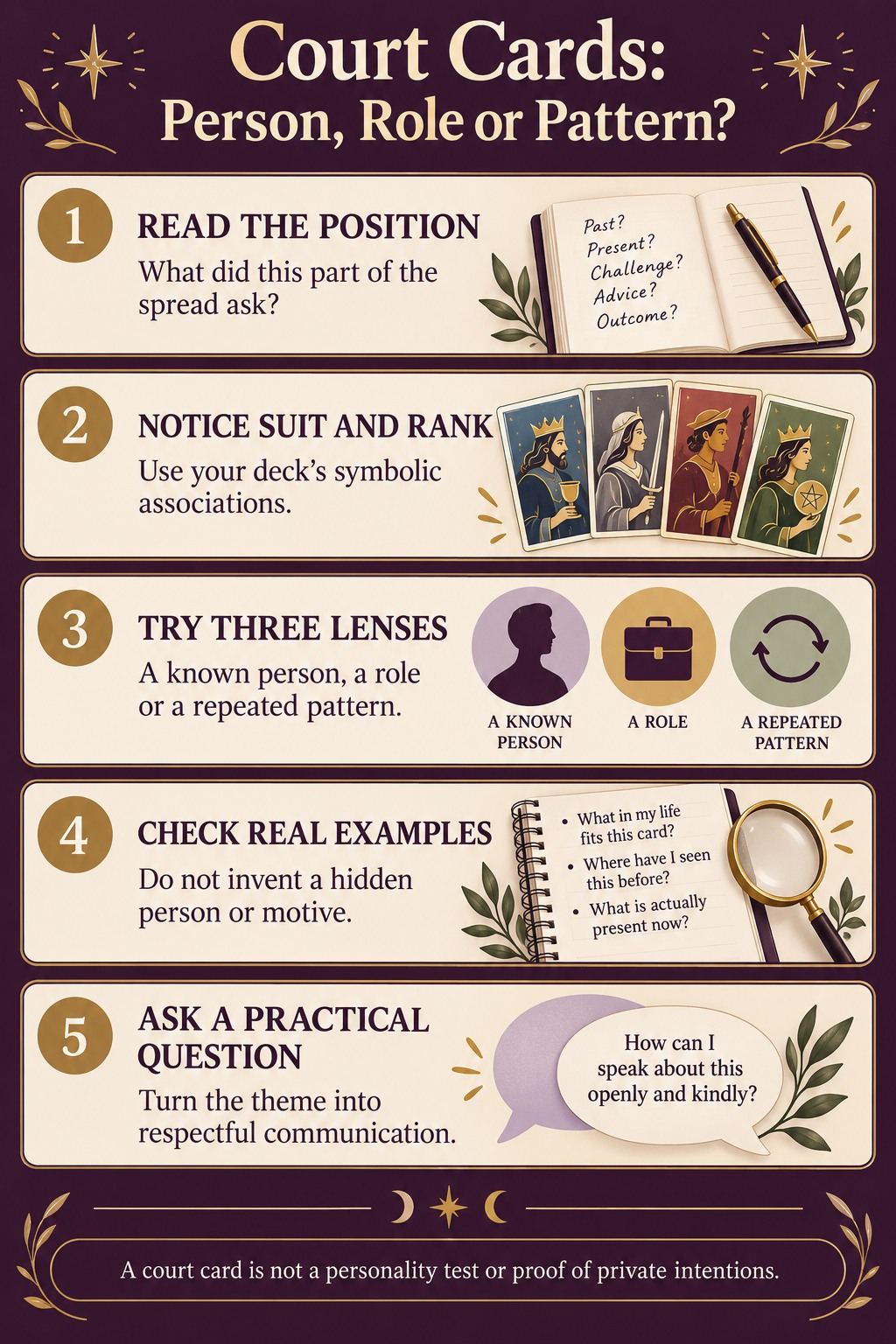
Read the infographic as text
- 1. READ THE POSITION: What did this part of the spread ask?
- 2. NOTICE SUIT AND RANK: Use your deck’s symbolic associations.
- 3. TRY THREE LENSES: A known person, a role or a repeated pattern.
- 4. CHECK REAL EXAMPLES: Do not invent a hidden person or motive.
- 5. ASK A PRACTICAL QUESTION: Turn the theme into respectful communication.
Reading the Suit
In some Tarot card approaches, the cups are associated with emotions and connections, swords with thought and communication, wands with initiative and desire, and pentacles with practical life and resources. These are things that change due to tradition and aren’t fixed. They are interpretive associations rather than traits discovered by reading a person.
When applied to love, the suits can help you ask different questions, such as “How are your feelings expressed?” and “How are disagreements talked about?”
No suit is automatically better for a love reading. Affection needs more than just emotional intensity, and reliability doesn’t mean there’s no tenderness. Don’t treat every one of the suits as a verdict that the relationship is good or bad.
The suit is a starting point for attention. Look at the theme and compare it to what you know and leave room for interpretation to be incomplete or unhelpful.
Look at What Each Court Card Rank Might Represent
One way to understand the tarot court cards is to think about the different roles they might represent. Pages can be connected with learning, curiosity, or exploring something new. Knights can represent taking action or going after something. Queens can be connected with developing or caring for certain qualities, while Kings can represent leadership, responsibility, or making decisions. This is only one way to understand the court cards, so you do not have to treat these meanings as strict rules.
If you are asking about a relationship, for example, a Page might encourage you to stay curious and learn more about the situation. A Knight could get you thinking about how quickly things are moving. A Queen might bring your attention to an emotional or personal quality that matters, while a King could get you thinking about things like responsibility, stability, or who is making important decisions.
Try not to automatically connect a court card with a certain gender, age, or relationship status. Pulling a Knight does not necessarily mean that an unreliable young man is about to appear in your life, just like pulling a Queen does not mean that the card has to represent a nurturing woman. Look at the card, your question, and the rest of the reading before deciding what makes the most sense.
You can also follow the meanings provided by the person who created your particular deck. The important thing is finding a method that makes sense to you and being consistent while you are learning. If you change the meaning of a card every time because another interpretation fits the answer you were hoping for, it can become difficult to tell what you are actually getting from the reading.
Be Careful When a Court Card Reminds You of Someone
Sometimes a court card might immediately remind you of someone you know. If that happens, think about what specifically made you connect that person with the card. For example, the King of Pentacles might remind you of a partner who is dependable when it comes to work, money, or taking care of practical responsibilities. That does not necessarily mean that every traditional meaning of the King of Pentacles describes that person.
Try not to identify someone only because of things like their hair color, skin tone, gender, or zodiac sign. Those descriptions are sometimes included in older tarot meanings, but they can limit your interpretation and cause you to overlook what the card might actually be bringing your attention to.
If you are reading about another person, especially someone who is not there, remember that the card is still being interpreted from your point of view. You might say, “This card reminds me of the way I feel when we have certain conversations,” instead of assuming that the card tells you exactly what the other person is secretly thinking or feeling.
Sometimes the most useful thing a tarot card can do is help you realize that there is something you need to talk about. If a card brings up a question about someone else’s feelings, intentions, or plans, you can use that as a starting point for a conversation. Their actual words and actions can then give you the information that the tarot card cannot.
Look at the Role
Sometimes a card describes what someone is doing in a certain interaction instead of who they are. One partner might take on the role of an organizer, and the other is the listener. These can be helpful, uneven, or ready to change roles.
Ask if the role is freely chosen and if both people understand it. A person might like organizing and still want to feel appreciated or have relief sometimes. Another might be willing to help but unaware that the arrangement doesn’t feel equal.
Role-based readings can make room for change. Instead of saying, “You’re responsible for this,” you can ask, “How can we share responsibility in this relationship?”
Pattern Interpretation
A court card can represent a way of acting that looks repeated. Maybe conversations go quickly from excitement to promises, or concerns are often postponed. The card can be a way to look at the pattern instead of a symbol for a hidden person.
Look for examples. One message doesn’t mean impulsiveness, and one missed call doesn’t mean emotional withdrawal. A pattern needs more than just one single moment that happens to fit the image.
Describe the pattern plainly: “We make plans before checking our schedules.” That gives both people an issue they can discuss, even if only one enjoys tarot. It is more useful than assigning unreliability to “Knight energy”.
Look at one change that can be made. You might agree to talk about availability before you commit to something. The value of the change will depend on whether it helps, not on whether the original card interpretation was correct.
A Queen of Cups Example About Listening
In a fictional reading, Jenna asks how she should approach a difficult conversation with her partner and pulls the Queen of Cups. At first, she thinks the card is telling her to focus completely on her partner’s feelings and put her own feelings aside.
After thinking about it more, Jenna looks at the card in a more balanced way. She can listen to what her partner has to say while still paying attention to her own feelings and needs. Before the conversation, she thinks about one thing she wants her partner to understand and one question she would like to ask about how they are feeling.
The Queen of Cups does not mean that Jenna has to agree with everything her partner says or always put their feelings before her own. Instead, she can use the card as a reminder to approach the conversation with compassion while still having healthy boundaries. If she feels afraid or intimidated by her partner, simply trying to become a better listener might not be enough to address the real problem.
This is also a good example of why the meaning of a tarot card can depend on the situation. Being caring and emotionally open does not mean ignoring your own needs or allowing someone to treat you badly. You can care about another person’s feelings while still protecting your own.
A Knight of Wands Example About Pace
In another fictional reading, Caleb pulls the Knight of Wands while thinking about a new romantic connection. He is excited about the person and has already started imagining things like taking trips together, even though they have only talked a few times.
Caleb could look at the Knight of Wands and immediately worry that it means the other person will lose interest or disappear. Instead, he uses the card to think about how quickly he is moving. He asks himself what they have actually talked about, which plans are only ideas right now, and what he would still like to learn about the person before making any bigger commitments.
He can continue enjoying the excitement of getting to know someone without feeling like he has to rush everything. He also does not need to assume that the other person is unreliable just because of the card he pulled. At the same time, he does not have to stop being excited simply because one interpretation of the Knight of Wands focuses on someone moving quickly or changing direction.
The card can simply remind Caleb that being excited about someone and actually knowing where the relationship is going are two different things. He can enjoy what is happening while giving the relationship enough time to develop and paying attention to what the other person actually says and does.
Different Cards and Exploration
Having many court cards doesn’t automatically mean that there are different romantic rivals. Depending on the question and method, they can represent different roles, common perspectives, or ways of responding to the same situation.
You should compare the qualities instead of counting the people. Does one card mean you should speak clearly, and does another suggest that you listen? Does one show initiative, and does the other show practical follow-through? These combinations can be a conversation about how you balance your life.
If you pick person-based interpretations, explain why each of these fits in the spread instead of guessing their identities. Don’t expand a reading into hidden characters whose existence isn’t supported.
Sometimes the best interpretation is enough, with different aspects of participation that need attention. You don’t need a detailed story about a secret influence to make the spread meaningful.
How to Handle Reversals
A reversed court card can be read in different ways depending on the method you choose. Some people look at the difficulty expressing a quality, inward focus, excess, or a need for adjustment. A reversal doesn’t automatically turn a person into a bad guy.
A reversed King of Swords, for example, might tell you to reflect on communication that feels unclear in a certain reading. It doesn’t diagnose a personality disorder, deception, or prove that someone is dangerous.
Connect the interpretation to behavior you can see in the card’s position. If you can’t do that without inventing your own fix, keep it as an unanswered possibility. Don’t use a reversal to justify spying on someone, confronting them, or having unwanted contact.
You can also choose to read all the cards upright. Decide this before the reading starts and then follow through with it. Reversals are an optional interpretive practice and aren’t a requirement for your spiritual understanding.
Asking Questions with the Cards
You can change your conclusion by asking an open-ended question. For example, if they are emotionally unavailable, you could say, “What kind of contact have we said that we want from each other?”
This kind of question is helpful because it invites information and choice. It doesn’t ask the other person to accept your tarot card ideas as proof. You can still talk about the issue in regular language.
The boundaries guidance from love is respect emphasizes the role of personal limits in relationships. A symbolic interpretation should support your ability to express those limits, not suggest that a particular card requires you to surrender them.
If an interpretation leaves you feeling stuck in a role, reconsider it. You’re the person with the circumstances that are changing and the preferences, not a character that’s assigned to you by the deck.
Final Thoughts: Create a Card Journal
For one card, record the question, position, and possible person interpretation. Also add a possible role interpretation and a possible pattern interpretation, then pick the one that best fits what you know or leave all of them open if there’s limited evidence.
This is a learning exercise, and it doesn’t show accuracy. The purpose is to make you see the choices, and you might find that you turn every court into someone else when the questions concern your own responses.
End the reading with a practical question or observation, and don’t keep pulling cards so you can decide which interpretation you want to be correct. If the situation needs another person’s answer, ask them if it’s appropriate and safe to do so.
Court cards are easier to read when you don’t demand that each one names a person. Let them give a perspective on participation, and let your relationship stay grounded in consent, communication, and what people are actually doing.
To explore card orientation in a love reading, see reversals in a relationship tarot spread.
For the next step, explore family patterns you can change.
Frequently asked questions
1. How many court cards are in a conventional tarot deck?
There are 16: Page, Knight, Queen and King in each of four suits. Your deck may use different names or an adapted structure.
2. Does a court card always represent a person?
No. It can also suggest a role, quality or behaviour pattern. Read the spread position before assigning a person.
3. What is a role interpretation?
It concerns participation in a situation, such as organising, listening or making decisions. A role can change and does not define the whole person.
4. What is a pattern interpretation?
It looks at repeated behaviour rather than identifying someone. Use concrete examples and avoid turning one incident into a permanent label.
5. Can the card identify my future partner?
It cannot establish a person’s identity or guarantee a future meeting. Treat descriptions as symbolic possibilities rather than verified information.
6. Must a Queen represent a woman?
No. Court ranks can represent qualities and roles for people of any gender. Follow an inclusive method that fits your deck and the reading.
7. Does a Page always mean someone young?
No. Learning or curiosity may be more useful associations than literal age. Do not force a person to match the title or artwork.
8. What can the suit add?
Common associations include Cups with emotion, Swords with communication, Wands with initiative and Pentacles with practical life. Traditions differ.
9. Is Cups always best for love?
No. Relationships also involve communication, initiative and practical responsibilities. No suit proves that a connection is healthy or doomed.
10. What can the Queen of Cups suggest?
In a reflective reading it may prompt compassionate listening. That does not require neglecting your own needs or accepting harmful behaviour.
11. What can the Knight of Wands suggest?
It may invite reflection on enthusiasm and pace. It does not prove that someone will disappear or act unreliably.
12. Do several court cards mean romantic rivals?
No. They may represent several roles or perspectives. Do not invent hidden people simply to account for every card.
13. Does a reversed court card mean a bad person?
No. Read the reversal through your chosen method and position. It cannot diagnose a personality disorder or establish deception.
14. What if a card immediately reminds me of someone?
Record the specific association, then consider other interpretations. Familiar artwork is not evidence that all traditional meanings apply to that person.
15. What should I record in a court-card journal?
Note the question, position, suit, rank and possible person, role and pattern readings. Keep uncertainty visible and end with one useful question.