“Ancestral baggage” can name the rules, fears, roles, and survival strategies a family passes forward. It can be spiritually meaningful without becoming a claim that biology or ancestors dictate your future.
Quick Guide
- Look for repeated family rules: silence, overwork, rescuing, conflict avoidance, or fear around money and love.
- Separate what you directly observed from stories, assumptions, and spiritual interpretations.
- Choose one small replacement behavior rather than trying to “heal the entire lineage.”
- Use rituals as reflective supports; use qualified care for trauma symptoms or unsafe family dynamics.
Notice
Name the repeating rule, role, trigger, or relationship pattern without blame.
Trace
Ask where you learned it and what purpose it may once have served.
Choose
Define a safer boundary or behavior that fits your values now.
Practice
Repeat the new response, review the outcome, and get support when needed.
What “Ancestral Baggage” Can Mean
The phrase is often used spiritually, but it can describe something very ordinary: families teach children how to respond to danger, affection, money, anger, success, grief, and belonging. Those lessons travel through stories, modeling, expectations, institutions, and culture. Some protect a family in one era and restrict later generations in another.
Spiritual traditions may frame repeated patterns as ancestral themes, soul lessons, or inherited energy. Those ideas can support reflection, but they should not be presented as objective proof that an ancestor is directing a person’s life. The relationship concepts discussed in karmic, soulmate, and twin-flame language work best under the same rule: the label should never outrank consent, evidence, or safety.
Family Patterns Are Not Fate
Common patterns include being the peacemaker, hiding problems, treating rest as laziness, avoiding money conversations, staying loyal at any cost, or expecting one person to carry everyone’s emotions. A pattern can be powerful without being permanent.
Human research on intergenerational trauma includes psychological, relational, social, prenatal, and possible epigenetic pathways. Yet researchers caution that true transgenerational epigenetic inheritance in humans remains difficult to establish because shared environments and other confounders are hard to separate. “It is in my DNA” is therefore not a sound reason to assume change is impossible.
Build a Family Pattern Map
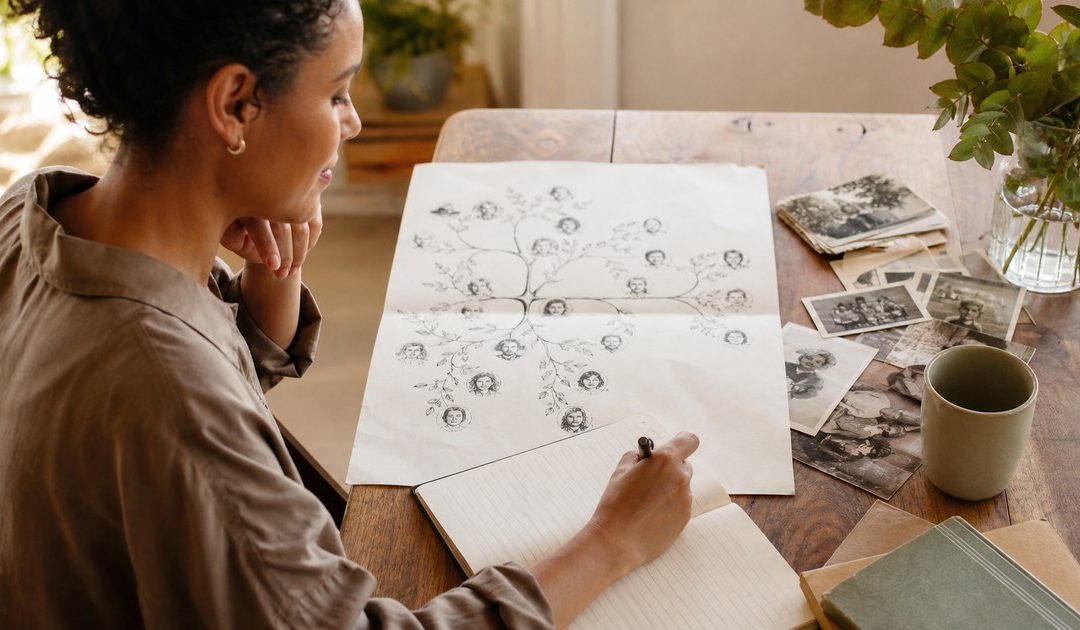
Draw three columns: what happened, what I learned, and what I choose now. Keep the first column factual. “Arguments ended with days of silence” is more useful than “our family has toxic energy.” The second column might reveal a rule such as “speaking up costs connection.” The third turns insight into action: “I will request a pause and name when we will return to the conversation.”
A genogram created with a therapist can add family roles, separations, losses, health concerns, migrations, and relationship patterns. For spiritual reflection, a journal or tarot spread can ask: What did this strategy protect? What does it cost now? What value do I want to carry forward?
Five Patterns Worth Examining
| Inherited rule | Possible cost | Replacement practice |
|---|---|---|
| Keep the peace at any price | Resentment and weak boundaries | Use a calm, specific “no” and tolerate disappointment. |
| Rest must be earned | Burnout and shame | Schedule recovery as maintenance, not a reward. |
| Family matters stay secret | Isolation and delayed help | Choose a safe, qualified confidant. |
| Love means rescuing | Overfunctioning and dependence | Offer support without taking over another adult’s choices. |
| Money is never discussed | Avoidance and confusion | Use simple budgets, questions, and transparent agreements. |
Using Ancestral Ritual Without Making Claims
A candle, photograph, recipe, song, letter, or place of remembrance can help someone honor resilience and name what they want to release. The mechanism need not be supernatural for the ritual to carry meaning. Write two lists: “what I keep” and “what stops with me.” Keep qualities such as courage, humor, or mutual care; release secrecy, cruelty, or self-abandonment.
Do not burn objects indoors, ingest unknown herbs, or use a ritual to confront an unsafe relative. Cultural practices should be learned from appropriate community sources, not copied from a generalized “ancestral cleansing” trend.
Boundaries Are a Form of Lineage Change
Large declarations are less important than repeatable actions. End a call when insults begin. Decline the role of family mediator. Tell a child that adults are responsible for adult emotions. Ask for consent before sharing a relative’s private history. These choices create a different model for whoever comes next.
Some people use the language of soul contracts to think about recurring bonds. Treat that as a personal framework, not an obligation to stay close to someone harmful. No spiritual story cancels the right to safety.
When Extra Support Helps
Consider a licensed mental-health professional when patterns involve trauma symptoms, abuse, addiction, eating concerns, severe anxiety, depression, or ongoing danger. A spiritually integrated therapist may be able to respect both cultural meaning and clinical needs. Change can include grief: giving up an old role may bring relief and sadness at the same time.
Key Takeaways
- Ancestral baggage is a useful metaphor for learned family rules, roles, and survival strategies.
- Human epigenetic research is complex and does not show that trauma creates an unavoidable biological destiny.
- Ritual can support reflection, but concrete boundaries and repeated behavior create change.
- Spiritual labels never require continued contact with someone unsafe or abusive.
Frequently Asked Questions
Is ancestral trauma stored in DNA?
Research examines possible epigenetic and biological pathways, but clear deterministic transgenerational inheritance in humans has not been established. Family environment, relationships, culture, and social conditions are also major pathways.
How do I know whether a family pattern is mine?
Ask where you learned it, when it appears, what it protects, and whether it still matches your values. A pattern can influence you without defining you.
Can a ritual heal ancestral baggage?
A ritual may help organize grief, intention, and meaning, but it is not a guaranteed treatment. Pair symbolic practice with boundaries, skills, community support, or professional care as appropriate.
Do I have to forgive relatives to break a cycle?
No. Change may involve compassion, distance, accountability, grief, or no contact. Forgiveness is personal and never a prerequisite for safety or recovery.